The Texas Almanac for 1868, "The Cotton Crop of Texas for 1867"
Title
Subject
Description
Source
Publisher
Date
Contributor
Language
Type
Date Submitted
Bibliographic Citation
Original Format
Text
The Cotton Crop of 1867
GALVESTON, NOVEMBER 1, 1867.
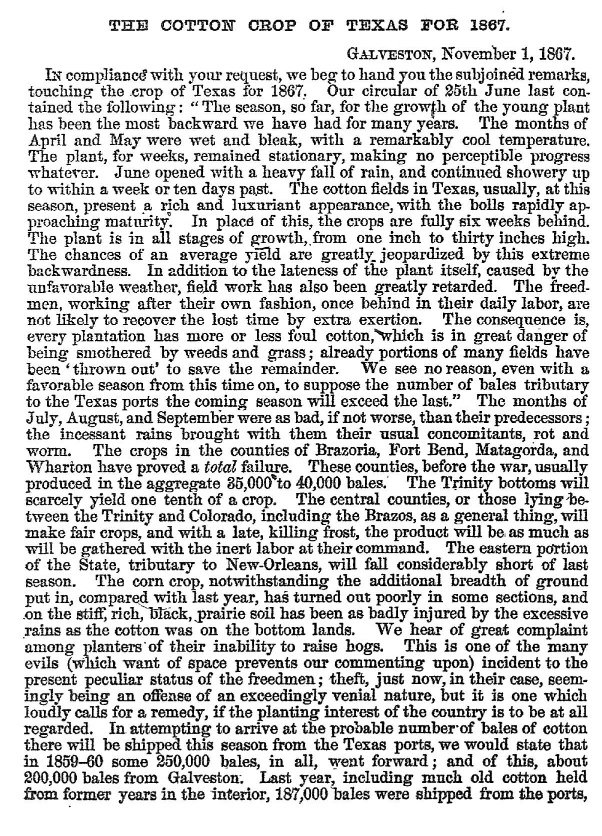
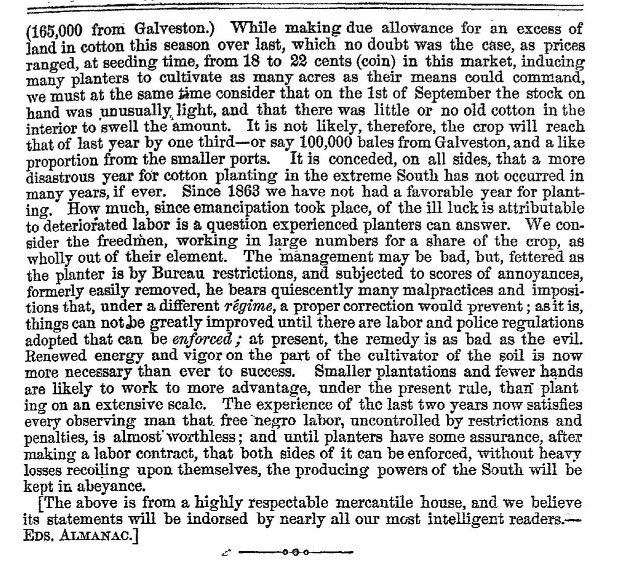
IN compliance with your request, we beg to hand you the subjoined remarks touching the crop in Texas for 1867. Our circular of 25th June last contained the following: "The season, so far, for the growth of the young plant has been the most backward we have had for many years. The months of April and May were wet and bleak, with a remarkably cool temperature. The plant, for weeks, remained stationary, making no perceptible progress whatever. June opened with a heavy fall of rain, and continued showery up to within a week or ten days past. The cotton fields in Texas, usually, at this season, present a rich and luxuriant appearance, with the bolls rapidly approaching maturity. In place of this, the crops are fully six weeks behind. The plant is in all stages of growth, from one inch to thirty inches high. The changes of an average yield are greatly jeopardized by this extreme backwardness. In addition to the lateness of the plant itself, caused by the unfavorable weather, field work has also been greatly retarded. The freedmen, working after their own fashion, once behind in their daily labor, are not likely to recover the lost time by extra exertion. The consequence is, every plantation has more or less foul cotton, which is in great danger of being smothered by weeds and grass; already portions of many fields have been 'thrown out' to save the remainder. We see no reason, even with a favorable season from this time on, to suppose the number of bales tributary to the Texas ports the coming season will exceed the last." The months of July, August, and September were as bad, if not worse, than their predecessors; the incessant rains brought with them their usual concomitants, rot and worm. The crops in the counties of Brazoria, For Bend, Matagorda, and Wharton have proved a total failure. These counties, before the war, usually produced in the aggregate 35,000 to 40,000 bales. The Trinity bottoms will scarcely yield one tenth of a crop. The central counties, or those lying between the Trinity and Colorado, including the Brazos, as a general thing, will make fair crops, and with a late, killing frost, the product will be as much as will be gathered with the inert labor at their command. The eastern portion of the State, tributary to New-Orleans, will fall considerably short of last season. The corn crop, notwithstanding the additional breadth of ground put in, compared with last year, has turned out poorly in some sections, and on the stiff, rich, black, prairie soil has been as badly injured by the excessive rains as the cotton was on the bottom lands. We hear of the great complaint among planters of their inability to raise hogs. This is one of the many evils (which want of space prevents our comment upon) incident to the present peculiar status of the freedmen; theft, just now, in their case, seemingly being an offense of an exceedingly venial nature, but it is one which loudly calls for a remedy , if the planting interest of the country is to be at all regarded. In attempting to arrive at the probable number of bales of cotton there will be shipped this season from the Texas ports, we would state that in 1859-60 some 250,000 bales, in all, went forward; and of this, about 200,000 bales from Galveston. Last year, including much old cotton held from former years in the interior, 187,000 bales were shipped from the ports, (165,000 from Galveston.) While making due allowance for an excess of land in cotton this season over last, which. no doubt was the case, as prices ranged, at seeding time, from 18 to 22 cents (coin) in this market, inducin gmany planters to cultivate as many acres as their means could command, we must at the same time consider that on the 1st of September the stock on hand was unusually light, and that there was little or no old cotton in the interior to swell the amount. It is not likely, therefore, the crop will reach that of last year by one third--or say 100,000 bales from Galveston, and a like proportion from teh smaller ports. It is conceded, on all sides, that a more disastrous year for cotton plantin gin the exreme South has not occurred in many years, if ever. Since 1863 we have not had a favorable year for planting. How much, since emancipation took place, of the ill luck is attirubtable to detriorated labor is a question experienced planters cna answer. We consider the freedmen, working in large numbers for a share of the crop, as wholly out of their element. The maangement may be bad, but, fettered as the planter is by Bureau restrictions, and subjected to scores of annoyances, formerly easily removed, he bears quiescently many malpractices and impositions that, under a different regime, a proper correction would prevent; as it is, things can not be greatly improved until there are labor and police regulations adopted that can be enforced; at present, the remedy is as bad as the evil. Renewed energy and vigor on the part of the cultivator of the soil is now more necessary than ever to success. Smaller plantations and fewer hands are likely to work to more advantage, under the present rule, that planting on an extensive scale. The experience of the last two years now satisfies every observingman that free negro labor, uncontrolled by restrictions and penalties, is almost worthless; and until planters have some assurance, after making a labor contract, that both sides of it can be enforced, without heavy losses recoiling upon themselves, the producing powers of the sSouth will be kept in abeyance.
[The above is from a highly respectable mercantile house, and we believe its statements will be indorsed by nearly all our most intelligent readers.--EDS. ALMANACE.]