State of the Crops (June 3, 1868)
Title
Subject
Description
Creator
Source
Publisher
Date
Contributor
Entry created by : Amy Earhart
Language
Type
Date Submitted
Bibliographic Citation
Text
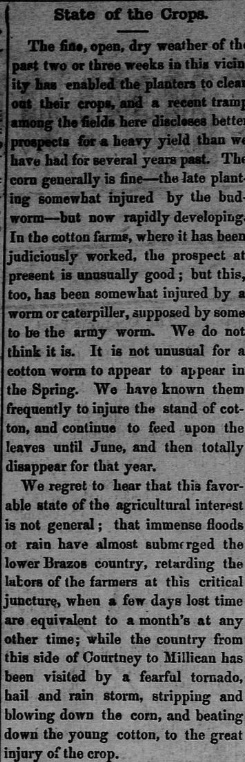
State of the Crops.
The fine, open, dry weather of the past two or three weeks in this vicinity has enabled the planters to clean out their crops, and a recent tramp among the fields here discloses better prospects for a heavy yield than we have had for several years past. The corn generally is fine—the late planting somewhat injured by the budworm—but now rapidly developing. In the cotton farms, where it has been judiciously worked, the prospect at present is unusually good; but this, too, has been somewhat injured by a worm or caterpiller , supposed by some to be the army worm. We do not think it is. It is not unusual for a cotton worm to appear to appear in the Spring. We have known them frequently to injure the stand of cotton, and continue to feed upon the leaves until June, and then totally disappear for that year.
We regret to hear that this favorable state of the agricultural interest is not general; that immense floods of rain have almost submerged the lower Brazos country, retarding the labors of the farmers at this critical juncture, when a few days lost time are equivalent to a month's at any other time; while the country from this side of Courtney to Millican has been visited by a fearful tornado, hail and rain storm, stripping and blowing down the corn, and beating down the young cotton, to the great injury of the crop.
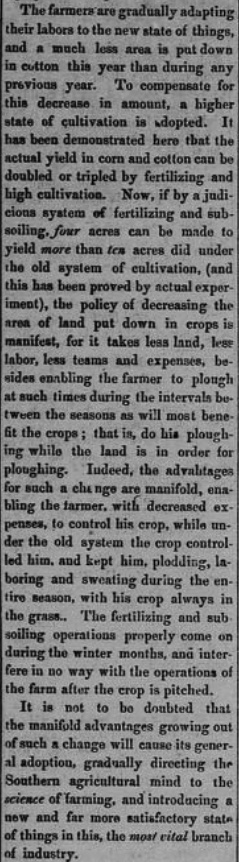
The farmers are gradually adapting their labors to the new state of things, and a much less area is put down in cotton this year than during any previous year. To compensate for this decrease in amount, a higher state of cultivation is adopted. It has been demonstrated here that the actual yield in corn and cotton can be doubled or tripled by fertilizing and high cultivation. Now, if by a judicious system of fertilizing and sub-soiling, four acres can be made to yield more than ten acres did under the old system of cultivation, (and this has been proved by actual experiment), the policy of decreasing the area of land put down in crops is manifest, for it takes less land, less labor, less teams and expenses, besides enabling the farmer to plough at such times during the intervals between the seasons as will most benefit the crops ; that is, do his ploughing while the land is in order for ploughing. Indeed, the advahtages for such a change are manifold, enabling the farmer, with decreased expenses, to control his crop, while under the old system the crop controlled him, and kept him, plodding, laboring and sweating during the entire season, with his crop always in the grass.. The fertilizing and sub soiling operations properly come on during the winter months, and interfere in no way with the operations of the farm after the crop is pitched.
It is not to be doubted that the manifold advantages growing out of such a change will cause its general adoption, gradually directing the Southern agricultural mind to the science of farming, and introducing a new and far more satisfactory state of things in this, the most vital branch of industry.