Letter from Washington County (1867-09-03)
Title
Subject
Description
Source
Publisher
Date
Contributor
Entry created by: Amy Earhart
Language
Type
Date Submitted
Bibliographic Citation
Text
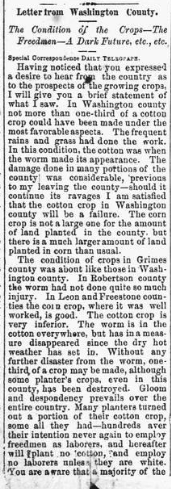
Letter from Washington County.
The Condition of the Crops—The Freedmen—A Dark Future, etc., etc.
Special Correspondence DAILY TELEGRAPH .
Having noticed that you expressed a desire to hear from the country as to the prospects of the growing crops, I will give you a brief statement of what I saw. In Washington county not more than one-third of a cotton crop could have been made under the most favorable aspects. The frequent rains and grass had done the work. In this condition, the cotton was when the worm made its appearance. The damage done in many portions of the county was considerable, previous to my leaving the county—should it continue its ravages I am satisfied that the cotton crop in Washington county will be a failure. The corn crop is not a large one for the amount of land planted in the county, but there is a much larger amount of land planted in corn than usual.
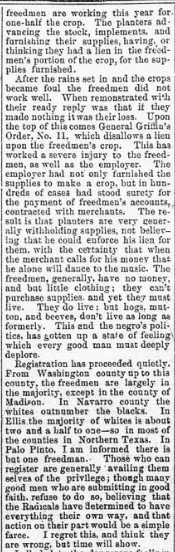
The condition of crops in Grimes county was about like those in Washington county. In Robertson county the worm had not done quite so much injury. In Leon and Freestone counties the corn crop, where it was well worked, is good. The cotton crop is very inferior. The worm is in the cotton everywhere, but has in a measure disappeared since the dry hot weather has set in. Without any further disaster from the worm, one-third, of a crop may be made, although some planter's crops, even in this county, has been destroyed. Gloom and despondency prevails over the entire country. Many planters turned out a portion of their cotton crop, some all they had—hundreds aver their intention never again to employ freedmen as laborers, and hereafter will plant no cotton, and employ no laborers unless they are white. You are aware that a majority of the freedmen are working this year for one-half the crop. The planters advancing the stock, implements, and furnishing their supplies, having, or thinking they had a lien in the freedmen's portion of the crop, for the supplies furnished.
After the rains set in and the crops became foul the freedmen did not work well. When remonstrated with their ready reply was that if they made nothing it was their loss. Upon the top of this comes General Griffin's Order, No. 11, which disallows a lien upon the freedmen's crop. This has worked a severe injury to the freed- men, as well as the employer. The employer had not only furnished the supplies to make a crop, but in hundreds of cases had stood surety for the payment of freedmen's accounts, contracted with merchants. The result is that planters are very generally withholding supplies, not believing that he could enforce his lien for them, with the certainty that when the merchant calls for his money that he alone will dance to the music. The freedmen, generally, have no money, and but little clothing; they can't purchase supplies and yet they must live. They do live; but hogs, mutton, and beeves, don't live as long as formerly. This and the negro's politics, has gotten up a stale of feeling which every good man must deeply deplore.
Registration has proceeded quietly. From Washington county up to this county, the freedmen are largely in the majority, except in the county of Madison. In Navarro county the whites outnumber the blacks. In Ellis the majority of whites is about two and a half to one—so in most of the counties in Northern Texas. In Palo Pinto, I am informed there is but one freedman. Those who can register are generally availing themselves of the privilege; though many good men who are submitting in good faith, refuse to do so, believing that the Radicals have determined to have everything their own way, and that action on their part would be a simple farce. I regret this, and think they are wrong, but time will show.
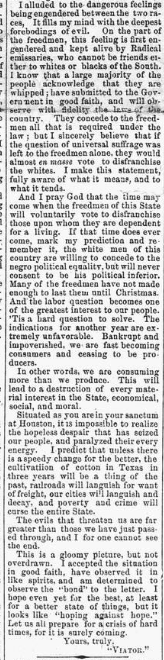
I alluded to the dangerous feelings being engendered between the two races, It fills my mind with the deepest forebodings of evil. On the part of the freedmen, this feeling is first engendered and kept alive by Radical emissaries, who cannot be friends either to whites or blacks of the South. I know that a large majority of the people acknowledge that they are whipped; have submitted to the Government in good faith, and will observe with fidelity the law of the country. They concede to the freedmen all that is required under the law ; but I sincerely believe that if the question of universal suffrage was left to the freedmen alone, they would almost en masse vote to disfranchise the whites. I make this statement, fully aware of what it means, and to what it tends.
And I pray God that the time may come when the freedmen of this State will voluntarily vote to disfranchise those upon whom they are dependent for a living. If that time does ever come, mark my prediction and remember it, the white men of this country are willing to concede to the negro political equality, but will never consent to be his political inferior. Many of the freedmen have not made enough to last them until Christmas. And the labor question becomes one of the greatest interest to our people. 'Tis a hard question to solve. The indications for another year are extremely unfavorable. Bankrupt and impoverished, we are fast becoming consumers and ceasing to be producers.
In other words, we are consuming more than we produce. This will lead to a destruction of every material interest in the State, economical, social, and moral.
Situated as you are in your sanctum at Houston, it is impossible to realize the hopeless despair that has seized our people, and paralyzed their every energy. I predict that unless there is a speedy change for the better, the cultivatiion of cotton in Texas in three years will be a thing of the past, railroads will languish for want of freight, our cities will languish and decay, and poverty and crime will curse the entire State.
The evils that threaten us are far greater than those we have just passed through, and I for one cannot see the end.
This is a gloomy picture, but not overdrawn. I accepted the situation in good faith, have observed it in like spirits, and am determined to observe the "bond" to the letter. I hope even yet for the best, at least for a better state of things, but it looks like "hoping against hope." Let us all prepare for a crisis of hard times, for it is surely coming.
Yours, truly.
"VIATOR."